

Going Home : Life in small town Texas.
Megargel, TX

Sometimes life takes you in so many different directions that it makes you wonder how you got to where you are.
Today, as I write this, I am 35 years old with a stepson, a dog, and a desire to see the world.
I'm pretty sure that desire stems from being stuck in "the middle of nowhere" for the first 18 years of my life.
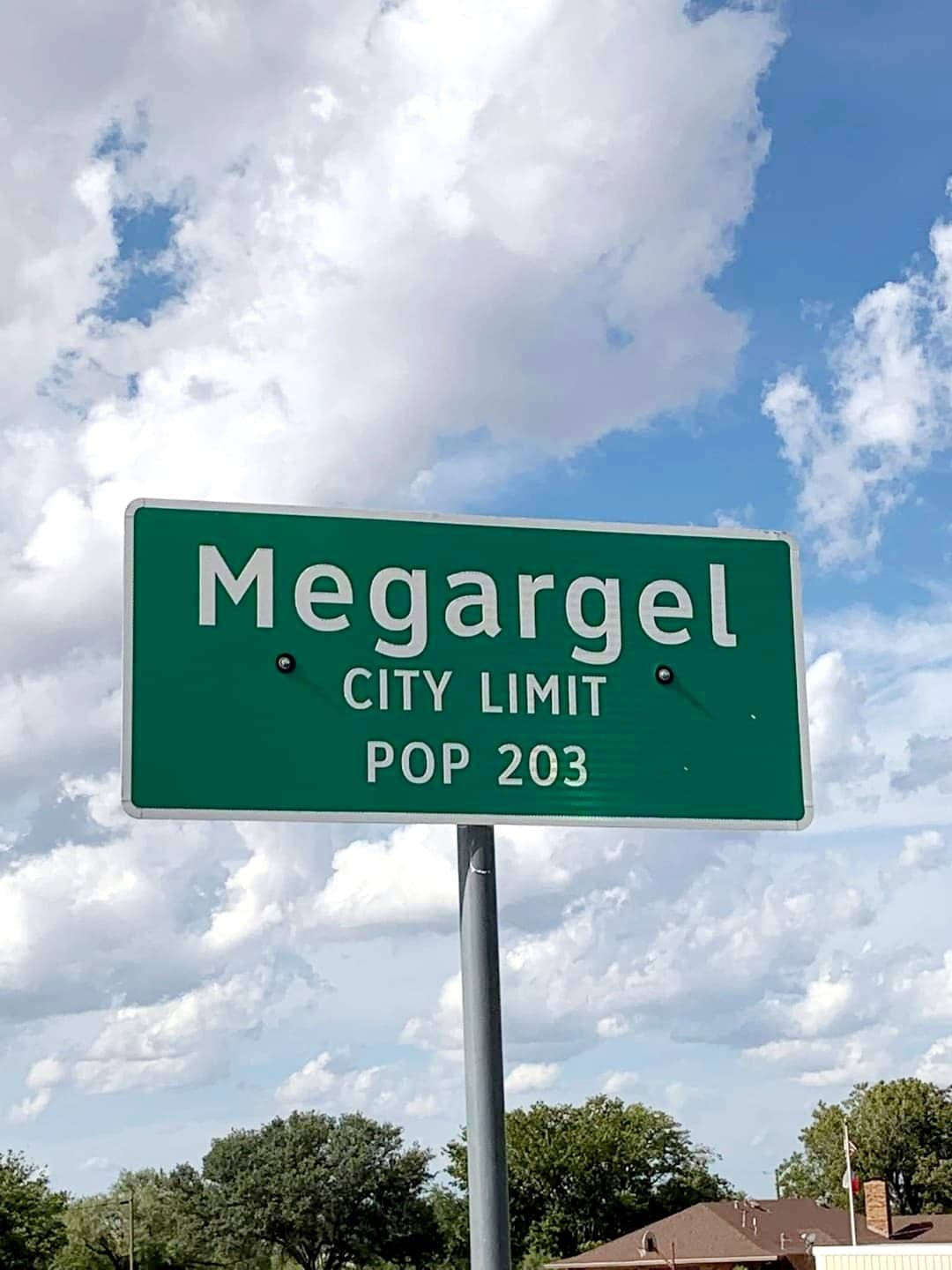
In this case, the middle of nowhere happens to be Megargel, Texas. Population 203, if you believe the sign.
When I say I grew up with more cows than people, it's mostly true.
Last November, Tony and our friend Cece got to visit the little town that raised me, as well as meet some of the important people who helped turn me into who I am today.
We headed out from Archer City, where my mother now resides, toward Megargel on the same windy road I've ridden on thousands of times before.
It was as though the path had been frozen in time.
My rocks. The cows. The trailers the hunters used.
Every part of the landscape seemed unchanged.
After about 20 minutes of driving through what seemed like nothing, an astonished Cece piped up:
"Where are the houses? I haven't seen one on this road."
To which Tony responded:
"This isn't the country. This is a desert."
We finally got into the little town that, admittedly, could use some repairs, where everything was all too familiar.
You could see cows in backyards, various pieces of tractor equipment scattered around my cousin Donnella's front yard, and about eight trucks surrounding the small one-bedroom house my daddy now lives in.
My daddy isn't as young as he used to be.
He's definitely part of the older generation in town now.
When Tony, Cece, and I walked in, we saw Daddy and Donnella sitting around his tiny table, just talking away with a neighbor.
The first thing he said was:
"Amber Jicole."
Then he got up to hug me before sitting back down.
Uncle Charles showed up a few minutes later—on his golf cart, of course—with his new dog in tow to ask if we wanted to play washers.
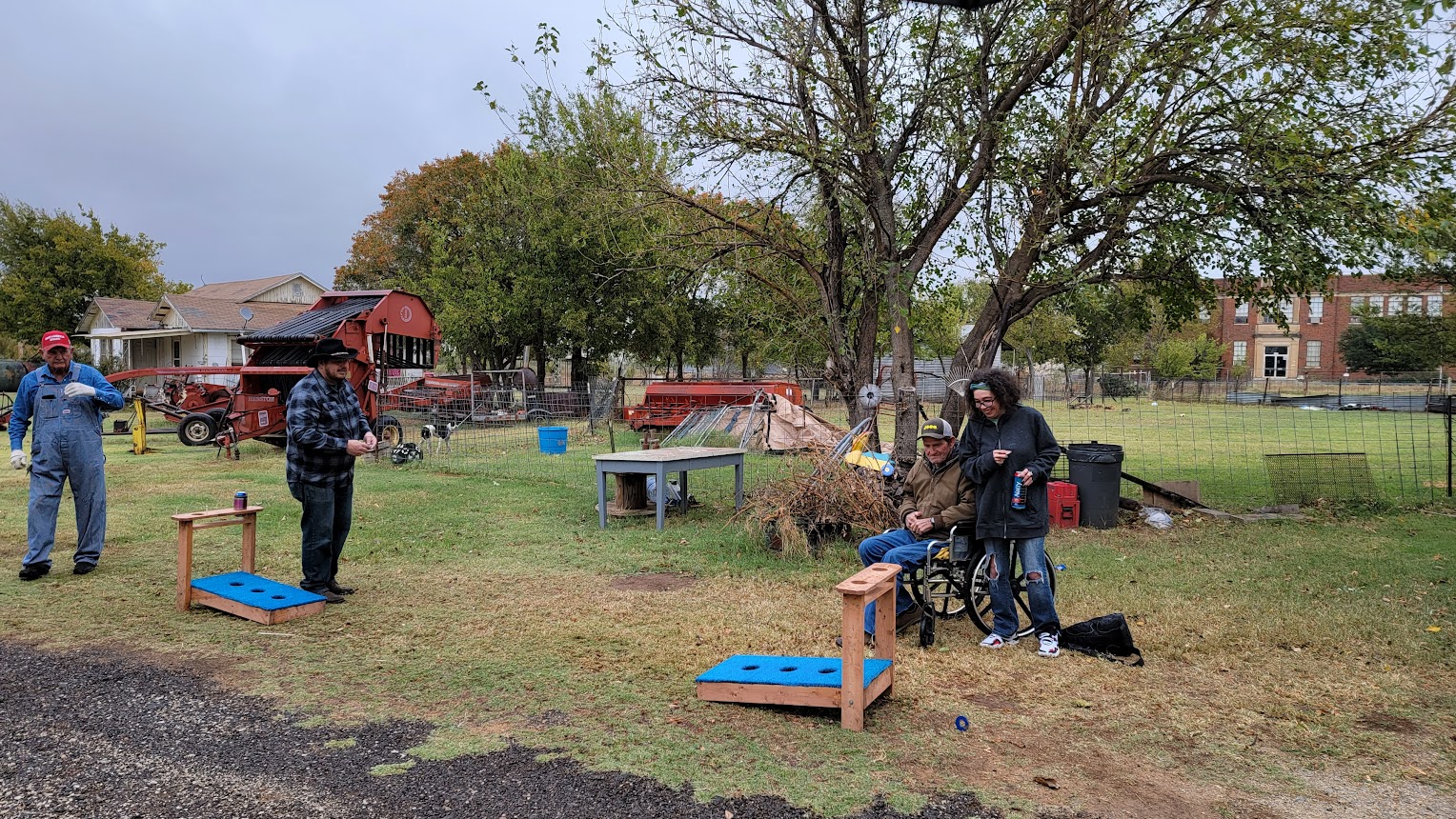
Daddy's pretty good at explaining how to play the game.
You have two boards. Some people play with one hole, but my family plays with three. In the case of my mother's boards, which she custom makes and sometimes sells, you even have a standing cup holder and a tee scoreboard just to make things slightly easier.
The boards are spaced 10 feet apart.
The object is to reach 21 points before the opposing team.
The top hole is worth three points, the middle is worth two, and the bottom is worth one. If all three washers land—and stay—on the board, you can also get one point.
First to 21 wins.
But if you go over?
You start back at 11.
.jpg)
The weather that day was extremely cold and drizzly, made worse by the slight wind.
Didn't stop any of the outside games, though.
Cece and Tony both learned how to play washers for the first time. Daddy and Uncle Charles split up so the new players wouldn't be at a disadvantage.
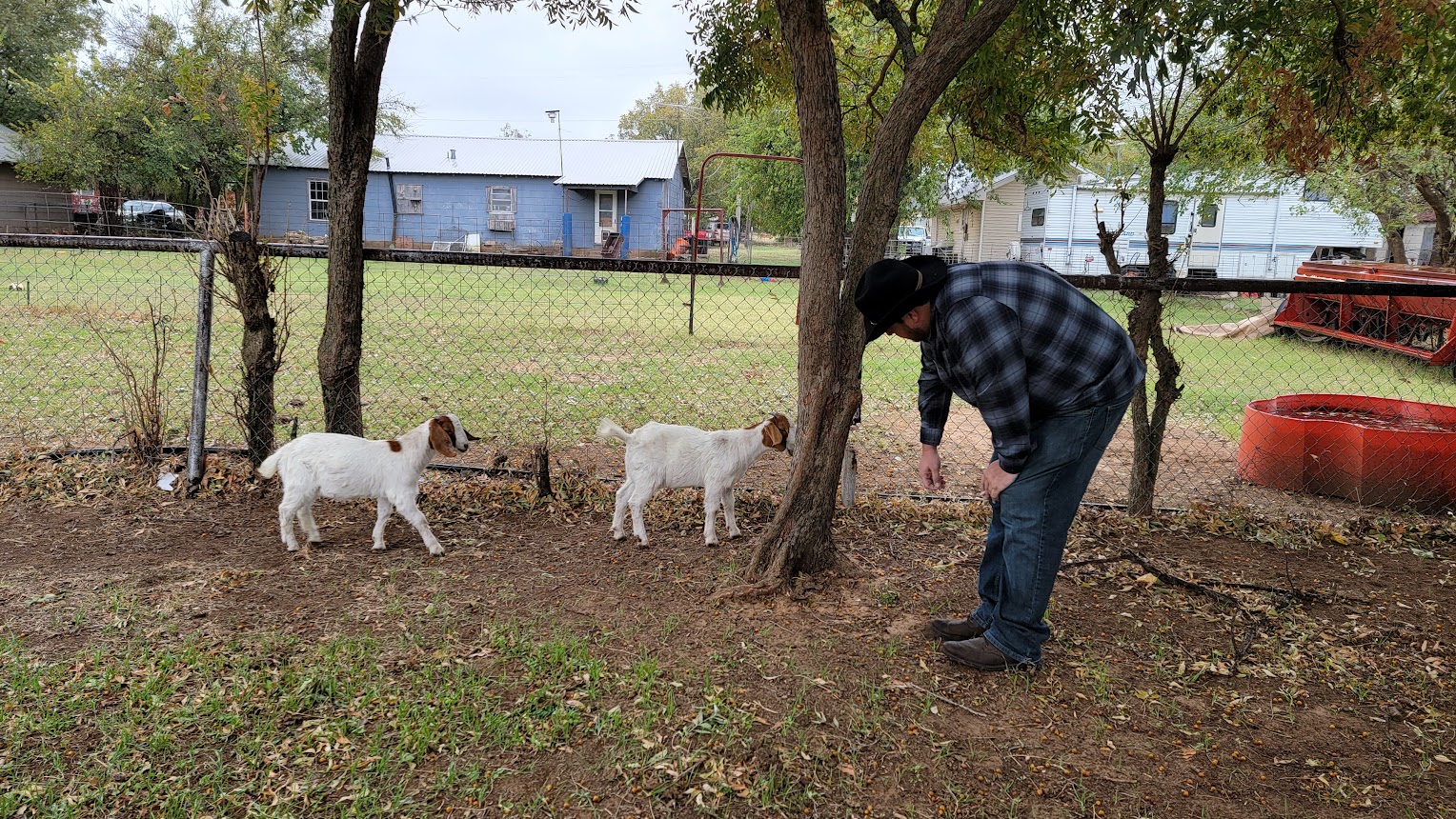
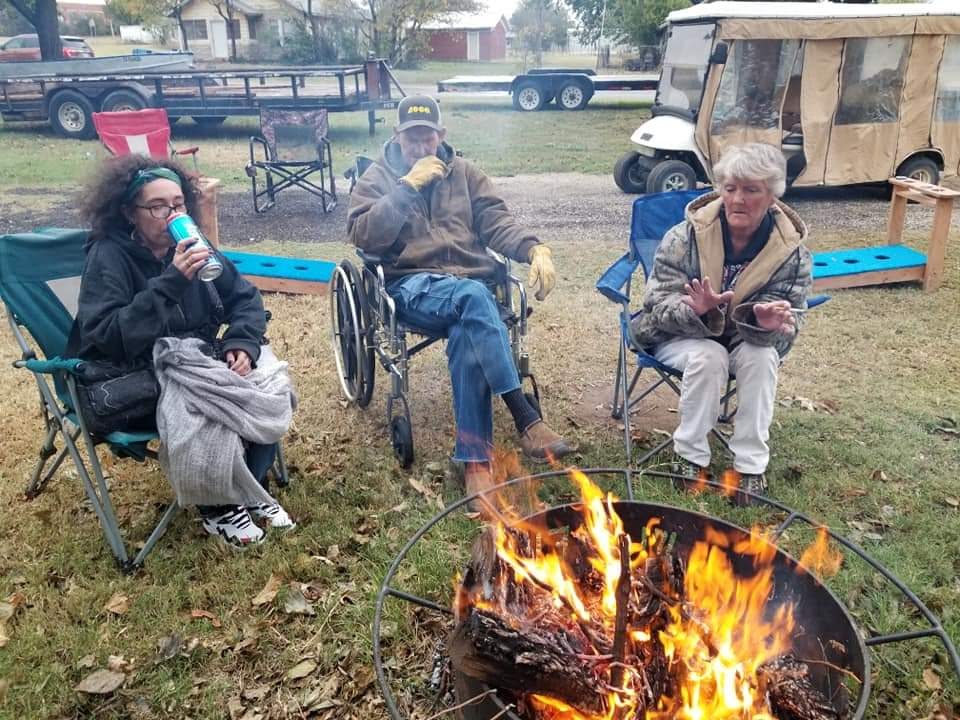
Eventually, Daddy built a fire, and I offered to show Cece the kids in Donnella's backyard.
I could tell by the look she was giving me that Cece was confused.
I forget sometimes that not everyone knows baby goats are called kids.
At one point, Cece ordered food for pickup from the gas station, just like I've done countless times in my life.
One of the only things that seemed to have changed was that now it was my cousin's daughter answering the phone.
See, there aren't any restaurants in Megargel.
No fast-food joints.
No grocery store.
It's always just been a combination gas station/liquor store...
And, of course, a feed store.
Because, ya know, livestock.
Once the rain finally became too much for us, we all headed inside and spent another 30 minutes talking away.
Then Uncle Charles came back with his truck and asked if we wanted to help him feed the cows.
Cece's face matched my son's expression whenever he gets the opportunity to pet, feed, or otherwise terrorize the cows.
.jpg)
Our trip was brief.
Although I didn't get to see my sisters this go-around, I did get to see my Aunt Retha for the first time in years.
Her house still felt the same as it did when I was younger, and I got flashbacks of getting haircuts in her kitchen.
We talked about her kids and her grandkids before I gave her a hug.
Then the three of us were on our way.
Or at least we thought we were on our way until we had to make several trips back because I couldn't find my phone.
Which, as it turns out, I hadn't actually lost.
My aunt didn't mind, though.
She's family and always, always will be.
The same goes for Uncle Charles and my daddy—the one who lives in Megargel.
None of them are related to me by blood.
But all of them have had such important roles in my life.
Sometimes I feel like life moves so fast.
There are so many things I haven't tried and so many places I haven't gone.
It sends shocks through me just thinking about how close my child is to becoming a teenager.
He's finally starting to take an interest in traveling again, and more than anything, that excites me.
But it also makes me feel as though he needs roots as much as I do.
Coming home after so many years to a town that's so set in its ways that it almost refuses to change reminded me of the difference between having roots and being stuck.
Maybe part of wanting to wander comes from growing up somewhere so small.
But no matter how many places I eventually see, there's something comforting about knowing there's still a windy road in Texas where the cows outnumber the people, my daddy will call me "Amber Jicole," Uncle Charles might show up on a golf cart, and somebody will probably ask if you want to play washers.
Sometimes you have to wander pretty far to understand what coming home means.